Saturday, May 7, 2011

Rachel Carson: GOOD or BAD?
Silent Spring is a book written by Rachel Carson and published by Houghton Mifflin on 27 September 1962. The book is widely credited with helping launch the environmental movement.  The book documented detrimental effects of pesticides on the environment, particularly on birds. Carson accused the chemical industry of spreading disinformation, and public officials of accepting industry claims uncritically.
Carson helped to spark the movement of environmental awareness and being eco-friendly.  She focused on the effect of hydrocarbons, such as DDT, an mosquito insecticide and organic phosphates, such as parathion, a common suicide agent used in Finland.  Both chemicals are harmful to not only the environment, but also mankind.  Carson suggested that instead of using DDT, people should use mosquito nets to combats the pests.
However, in suggesting this, Carson made others believe that mosquito nets would solve huge mosquito invasions, often seen in Africa.  Malaria is prevalent, and although the mosquito nets were some help to the inhabitants of such areas,  DDT also could have been used using the selective spraying technique.  It is the overuse of the chemicals that weighs heavily on the environment.   Overall, I think Carson's book helped open people eyes, but it did not do the whole job Carson intended it to do.
Global Poverty at its worst?

At least 80% of humanity lives on less than $10 a day.  More than 80 percent of the world’s population lives in countries where income differentials are widening.  The poorest 40 percent of the world’s population accounts for 5 percent of global income. The richest 20 percent accounts for three-quarters of world income.  According to UNICEF, 22,000 children die each day due to poverty. And they “die quietly in some of the poorest villages on earth, far removed from the scrutiny and the conscience of the world. Being meek and weak in life makes these dying multitudes even more invisible in death.”  Around 27-28 percent of all children in developing countries are estimated to be underweight or stunted. The two regions that account for the bulk of the deficit are South Asia and sub-Saharan Africa.  If current trends continue, the Millennium Development Goals target of halving the proportion of underweight children will be missed by 30 million children, largely because of slow progress in Southern Asia and sub-Saharan Africa.  Based on enrollment data, about 72 million children of primary school age in the developing world were not in school in 2005; 57 per cent of them were girls. And these are regarded as optimistic numbers.  Nearly a billion people entered the 21st century unable to read a book or sign their names.  Less than one per cent of what the world spent every year on weapons was needed to put every child into school by the year 2000 and yet it didn’t happen.  Infectious diseases continue to blight the lives of the poor across the world. An estimated 40 million people are living with HIV/AIDS, with 3 million deaths in 2004. Every year there are 350–500 million cases of malaria, with 1 million fatalities: Africa accounts for 90 percent of malarial deaths and African children account for over 80 percent of malaria victims worldwide.

What is Life?
Life is defined as condition that distinguishes animals and plants from inorganic matter, including the capacity for growth, reproduction, functional activity, and continual change 
preceding death.  Do you agree with this definition?  I'm not quite sure I agree.  Initially, when I think of life, I think of humans and animals, and maybe even plants.  I have to the tendency to relate life with the ability to breathe; however, life is so much more complex than that.  I believe that viruses are alive, hence the term "live viruses" :) However, I truly believe life is relative.  Everyone is going to have a different definition for life so it's difficult to put a concrete explanation as to what life is.

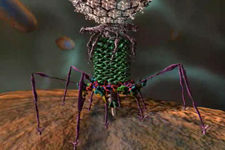
artist conceptin of T4 virus as it penetrates cell membrane of E. coli

Monday, April 25, 2011

3 Diets for 3 Blood Types 
Some scientists have come up with a diet for which one should use based on his or her blood type.  If you use the Mitochondrial eve theory, one can possibly see where this diet originated from.  As the population spread from central Africa, the nutrients needed for survival evolved as well along with the blood types of the people who migrated from the central location of civilization. Most of the population has blood type O. Here the prescribed diet is low-carbohydrate, high in proteins (such as meat and fish), and low in dairy products. There are specific foods to avoid; such as avocados, brazil nuts, and oranges. Type O should also engage in lots of exercise.  Blood Type A should avoid red meat, eat plenty of fish and vegetables, with a low dairy intake. Light exercise only.  Blood Type B should avoid chicken and bacon, eat plenty of meat and dairy, some fish, and plenty of fruit and vegetables.
Blood Type AB combines the A and B diets.

Friday, March 25, 2011


An artist's impression of Mitochondrial Eve who probably lived in Africa, about 150,000 years ago.
The Mitochondrial Eve theory discusses the idea that everyone in the world is descended from one woman.  Her name is "Mitochondrial" eve refers to her being our matrilineal most common ancestor.  Humans share Mitochondrial DNA with their mothers; this would mean that  everyone shares a small percentage of mitochondria with each other, which descended from Mitochondrial Eve.  Scientists believe that Mitochondrial Eve lived in the region of Northeast Africa.  From here, people dispersed to the now inhabited areas of the earth.   Over time, as the people dispersed, their physical features changed to better suit their new climates.
Ethiopians tend to have naturally straight hair, slender noses, lighter complexions, and overall slender body frames than people from other African nations.
 Nigerian people physical features are quite the opposite from Ethiopians.  They have stockier builds, broader noses, and tend to be of a darker complexion.
Filipino people tend to have rounder eyes than the Chinese; they also tend to have light to medium skin tones and medium body sizes, yet short heights.
Indian people tend to have medium to dark complexions, with straight black hair and average builds.
Mexican people tend to have medium to dark skin, with fuller bodies and short builds, as well as dark hair.

Thursday, February 24, 2011

Extremophiles


Extremophiles are organisms that are capable of thriving and surviving in environments that would usually be detrimental to most organisms on Earth.  The extremophile shown below is Pyrolobus fumarii.  It is a hyperthermophile, meaning it can withstand extremely high temperatures.  Pyrolobus fumarii was first discovered in 1997 in a black smoker hydrothermal vent at the Mid-Atlantic Ridge, setting the upper temperature threshold for known life to exist at 113°C. Strain 121, a microbe from the same family found at a vent in the Pacific Ocean, survived and multiplied during a 10-hour interval spent at 121°C in an autoclave. It was finally killed at a temperature of 130°C.

Deinococcus radiodurans

HOW TO MAKE A BED

Objective:  To successfully make a bed in a neat manner.

Materials:
-fitted sheet
-flat sheet
-pillows
-blanket 

1.  Put the fitted bottom sheet in place. Pull the fitted bottom sheet elastic tightly and evenly over the mattress corners. Smooth from the center, then tucking under the sides.

2.  Add the flat sheet. Spread it out evenly across the bed, allowing any extra to fall at the bottom edge. Tuck in the bottom edge. Pick up the side edge at the bottom corner and hold it out. Tuck in what is left hanging down at the corner, then let the edge fall and tuck it in as well. Repeat for the other bottom corner.

3.  Put blanket over the sheets. Place blanket right side up with the top of the blanket at the point where you turn down the flat sheet. Fold down the top sheet over the top edge of the blanket. Now the good side of the sheet is showing. Tuck in the entire side by the wall.

4.  Fluff out the pillows and place them at the top of the bed.