Saturday, May 7, 2011

Rachel Carson: GOOD or BAD?
Silent Spring is a book written by Rachel Carson and published by Houghton Mifflin on 27 September 1962. The book is widely credited with helping launch the environmental movement.  The book documented detrimental effects of pesticides on the environment, particularly on birds. Carson accused the chemical industry of spreading disinformation, and public officials of accepting industry claims uncritically.
Carson helped to spark the movement of environmental awareness and being eco-friendly.  She focused on the effect of hydrocarbons, such as DDT, an mosquito insecticide and organic phosphates, such as parathion, a common suicide agent used in Finland.  Both chemicals are harmful to not only the environment, but also mankind.  Carson suggested that instead of using DDT, people should use mosquito nets to combats the pests.
However, in suggesting this, Carson made others believe that mosquito nets would solve huge mosquito invasions, often seen in Africa.  Malaria is prevalent, and although the mosquito nets were some help to the inhabitants of such areas,  DDT also could have been used using the selective spraying technique.  It is the overuse of the chemicals that weighs heavily on the environment.   Overall, I think Carson's book helped open people eyes, but it did not do the whole job Carson intended it to do.
Global Poverty at its worst?

At least 80% of humanity lives on less than $10 a day.  More than 80 percent of the world’s population lives in countries where income differentials are widening.  The poorest 40 percent of the world’s population accounts for 5 percent of global income. The richest 20 percent accounts for three-quarters of world income.  According to UNICEF, 22,000 children die each day due to poverty. And they “die quietly in some of the poorest villages on earth, far removed from the scrutiny and the conscience of the world. Being meek and weak in life makes these dying multitudes even more invisible in death.”  Around 27-28 percent of all children in developing countries are estimated to be underweight or stunted. The two regions that account for the bulk of the deficit are South Asia and sub-Saharan Africa.  If current trends continue, the Millennium Development Goals target of halving the proportion of underweight children will be missed by 30 million children, largely because of slow progress in Southern Asia and sub-Saharan Africa.  Based on enrollment data, about 72 million children of primary school age in the developing world were not in school in 2005; 57 per cent of them were girls. And these are regarded as optimistic numbers.  Nearly a billion people entered the 21st century unable to read a book or sign their names.  Less than one per cent of what the world spent every year on weapons was needed to put every child into school by the year 2000 and yet it didn’t happen.  Infectious diseases continue to blight the lives of the poor across the world. An estimated 40 million people are living with HIV/AIDS, with 3 million deaths in 2004. Every year there are 350–500 million cases of malaria, with 1 million fatalities: Africa accounts for 90 percent of malarial deaths and African children account for over 80 percent of malaria victims worldwide.

What is Life?
Life is defined as condition that distinguishes animals and plants from inorganic matter, including the capacity for growth, reproduction, functional activity, and continual change 
preceding death.  Do you agree with this definition?  I'm not quite sure I agree.  Initially, when I think of life, I think of humans and animals, and maybe even plants.  I have to the tendency to relate life with the ability to breathe; however, life is so much more complex than that.  I believe that viruses are alive, hence the term "live viruses" :) However, I truly believe life is relative.  Everyone is going to have a different definition for life so it's difficult to put a concrete explanation as to what life is.

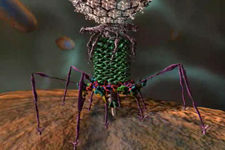
artist conceptin of T4 virus as it penetrates cell membrane of E. coli